
REVIEW · OLD TOWN TAPAS WALKS
Barcelona in One Day: Gaudí, Gothic Quarter &Tapas (Private Tour)
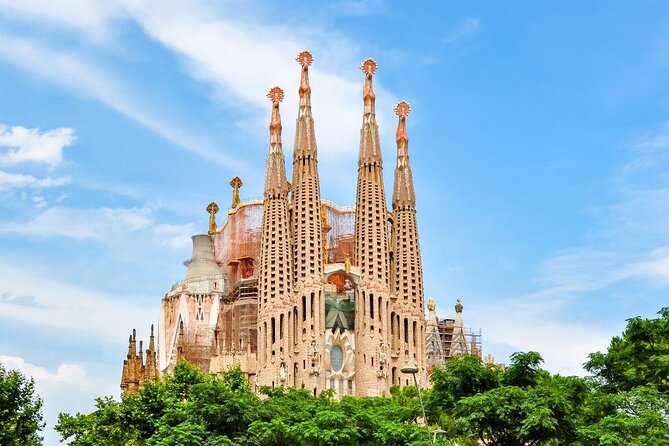
Barcelona’s best sights are spread across a compact but busy city, and this private five-hour tour gives you a fast way to connect the dots. You move from Roman Barcelona and the medieval Gothic Quarter to Gaudí’s fanciful apartment houses, then finish inside Sagrada Família when the day’s crowds are said to thin.
I like the personal format, since your guide can adjust the pace and spend more time on what catches your eye. I also like the mix of major sights and smaller stops, from the old Jewish Quarter to the bronze letters spelling Barcino. The main drawback is the ambitious schedule: this is a walking-heavy overview, not a slow visit to every landmark, and the advertised route may be shortened if your group arrives late, tires easily, or lingers.
Key things to know before booking
- Sagrada Família is the grand finale: The one-hour interior visit is included, with an afternoon start intended to avoid the thickest crowds.
- You see the city in layers: Roman Barcelona, medieval squares, Catalan government buildings, Modernisme architecture, and local food all fit into one route.
- It is private, not a shared group tour: Only your party takes part, so your guide can respond to your questions and adjust the pace.
- Expect plenty of walking: One five-hour outing covered about 12,000 steps, so comfortable shoes matter.
- Tapas are part of the appeal: The food portion has included nougat at Planelles Donat and pintxos, wine, and beer at Orio, though exact arrangements can vary.
- The value depends on your priorities: At $264.34 per person, the tour makes more sense for a first visit, a short stay, or a family group that values a private guide and organized entry to Sagrada Família.
Why this five-hour route works for a first Barcelona visit
Barcelona can feel like several cities layered on top of one another. The Gothic Quarter follows the shape of Roman Barcino, La Rambla cuts through the old city, and the Eixample opens into the grand avenues where Gaudí and his fellow Modernista architects built their showpiece homes.
This tour links those areas without asking you to plan each connection yourself. You begin at Av. de la Catedral, 7, in the old city, then work through medieval Barcelona before heading toward La Rambla and the Eixample. The route finishes at Sagrada Família, where you have a full hour inside.
The private format is the strongest reason to choose it. Guides named in past bookings include Olga, Carla, Anna, Valentina, Pol, and Viggo. The best descriptions of the guiding style point to warm conversation, clear historical explanations, humor, and flexibility. You are not simply being marched from one photo stop to the next.
Still, keep the word overview in mind. The itinerary lists eleven places, but several are exterior viewpoints or short visits. Casa Batlló and La Pedrera receive only about ten to fifteen minutes each, and the Cathedral visit is listed at ten minutes. If you want to study Gaudí’s interiors, climb a tower, or linger over medieval architecture, you will need separate time.
More Old Town Tapas Walks in Barcelona
- Barcelona Gothic Quarter Tapas & Taverns Food & Wine Tour
★ 5.0 · 1,470 reviews - Barcelona: El Born and Gothic Quarter Wine & Tapas Bar Tour
★ 4.8 · 674 reviews - Barcelona Old Town Tapas Tour: Vermouth, Bites & Hidden Gems
★ 5.0 · 627 reviews
Plaça Nova and the Roman roots of Barcino
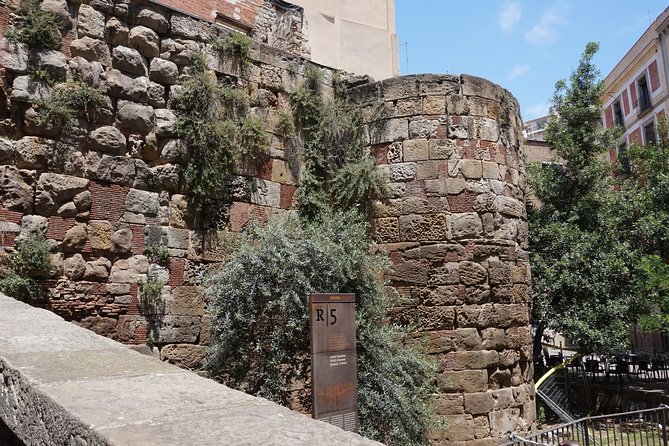
Your starting point, Plaça Nova, sits beside the remains of Barcelona’s Roman wall. Seven large letters spell Barcino, the principal Roman name connected with the city’s origins. Joan Brossa designed the installation, using six bronze letters and one aluminum letter.
It is a clever opening because it does more than point you toward an old wall. The letters form a modern visual poem against ancient stone, which is very much in keeping with Barcelona’s habit of placing contemporary art beside older buildings.
You spend about ten minutes here, so expect an introduction rather than a full Roman archaeology lesson. That is fine at the start of a tightly timed tour. It gives you a useful frame for understanding why the Gothic Quarter is not simply medieval.
Barcelona Cathedral and the quiet corners of the old city
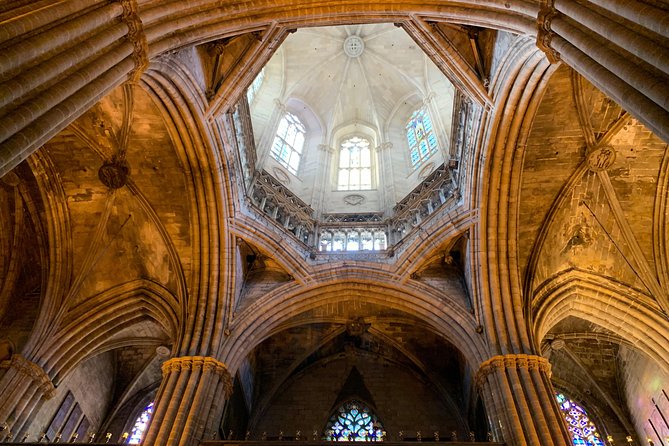
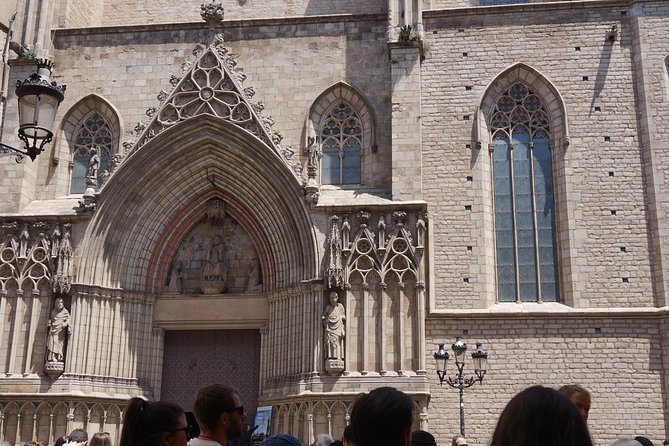
The Cathedral of Barcelona brings you into the Gothic period. Inside, you can see the broad nave, chapels, and the cloister with its fountain. The building was constructed over several centuries, which helps explain the mix of details and the scale of the complex.
Admission to the Cathedral is not included in the listed tour price. That is an important cost detail to confirm before you go, especially since the visit is brief. The route allows about ten minutes, enough for a focused look but not a long architectural study.
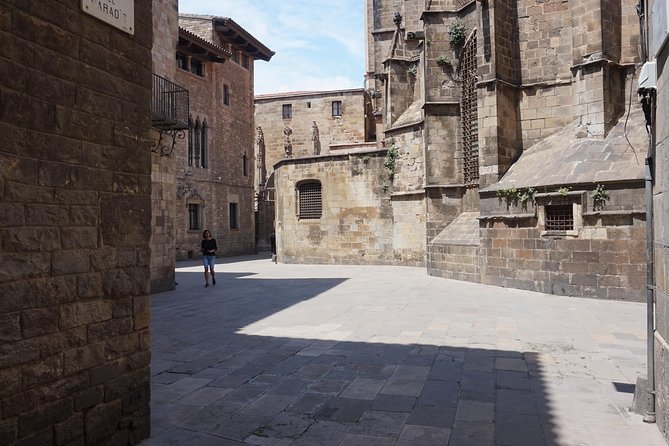
Nearby, Casa de l’Ardiaca offers a smaller and more intimate stop. This former residence of the ecclesiastical hierarchy began in the 12th century and was altered over time. Its central courtyard combines Renaissance decoration with the original Gothic character, while the upper terrace has a romantic balcony that feels almost theatrical.
The building is a good example of why a private guide can add value. A casual walk through the quarter might leave you focused on the Cathedral’s façade. A guide can point out how power, religion, and domestic life occupied the same tight medieval streets.
Plaça del Rei and Plaça de Sant Jaume
Plaça del Rei is one of the clearest pictures of medieval Barcelona. The royal palace, Palau Reial Major, and nearby buildings enclose a calm square that once reflected the city’s royal importance.
You have about ten minutes here. That short pause works best if you want the guide to explain the square’s role and identify the surrounding buildings. It is less suitable if you hope to enter every museum or palace in the area.
Plaça de Sant Jaume shifts the story from royal power to civic power. It has served as Barcelona’s political center for centuries and now contains the City Hall and the Palau de la Generalitat, the seat of Catalonia’s government. The square also acts as an open breathing space in the narrow Gothic Quarter.
These two plazas make a useful pair. Plaça del Rei shows medieval authority in a formal setting, while Plaça de Sant Jaume connects Barcelona’s past with its present political life. You get only ten minutes at each, but together they give the old city a clear shape.
Same streets, a different round:
- Montserrat Half-Day Tour with Tapas and Gourmet Wines
★ 5.0 · 7,359 reviews - Montserrat & Cogwheel Train, Gourmet Wine Tasting & Tapas/Lunch
★ 5.0 · 6,290 reviews - Barcelona Tapas and Wine Experience Small-Group Walking Tour
★ 5.0 · 5,804 reviews - Montserrat with Black Madonna & Medieval Winery with Tapas/Lunch
★ 5.0 · 5,209 reviews
The old Jewish Quarter in five focused minutes
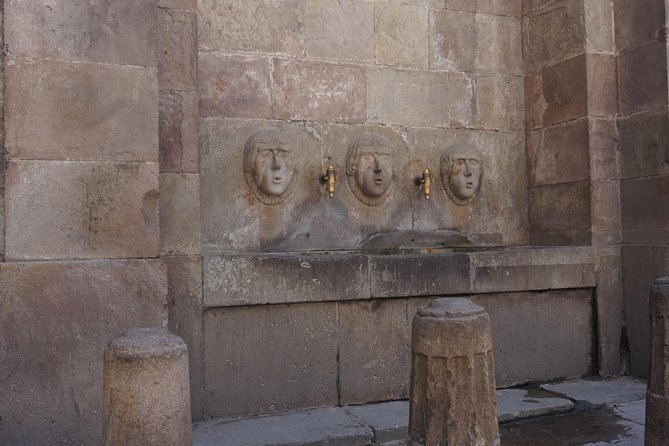
The Sinagoga Major de Barcelona is one of the most distinctive stops on the route. The medieval Jewish Quarter, known through the term calls, once supported a large community between the ninth and fourteenth centuries. The synagogue has been restored and opened to the public.
The planned visit is only five minutes, and admission is listed as free. That makes this a quick orientation stop rather than a full museum visit. You will want to listen closely while the guide explains how the narrow streets preserve traces of a community that was central to medieval Barcelona.
I appreciate the inclusion because it widens the story beyond kings, churches, and famous architects. The Gothic Quarter was also a place of Jewish learning, trade, worship, and daily life. If this subject interests you, ask your guide whether the schedule allows a little extra time here.
La Rambla and Boqueria Market
La Rambla runs about 1.2 kilometers through the old city. It follows the line of the medieval walls and became a shared public promenade in the 18th century. The route gives you about fifteen minutes along the boulevard, enough to understand its layout and watch the city move around you.
Do not expect a complete stroll from end to end during this tour. The schedule is too full. Instead, you get a practical introduction to Barcelona’s most famous pedestrian avenue before entering Mercat de la Boqueria.
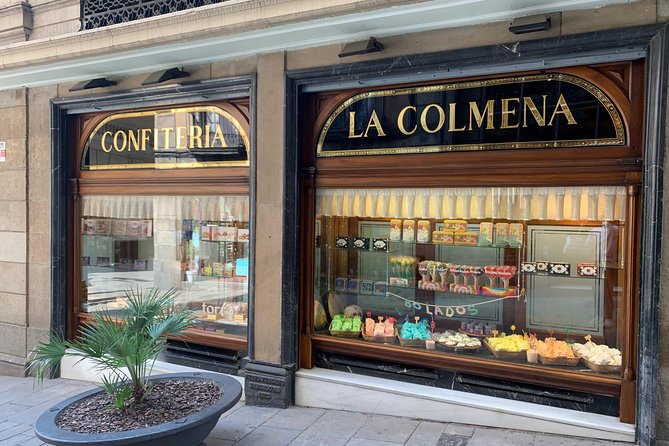
Boqueria is one of the tour’s more useful food stops. Its story reaches from street sellers to a modern market filled with produce, prepared foods, and colorful displays. You have about thirty minutes, which gives you time to look around and sample something if the group’s food plans allow.
Past outings have included traditional nougat at Planelles Donat and a later stop at Orio for pintxos, wine, and beer. The supplied route does not give a precise tapas venue or menu, so you should treat the food portion as a guided taste of Barcelona rather than a fixed restaurant package. If you have allergies or strong food restrictions, discuss them before booking.
The market can be crowded, and thirty minutes passes quickly. Keep your belongings secure and stay aware of the meeting point. The market is most valuable when you let the guide explain what you are seeing instead of treating it as a rushed photo stop.
Casa Batlló and La Pedrera on the Passeig de Gràcia
After the old city, the route shifts to the Eixample and Gaudí’s famous residential work. Casa Batlló is one of the most eye-catching buildings on Passeig de Gràcia. Its façade uses curved stone, irregular oval windows, colorful broken ceramic tiles, and a roof often compared with a dragon’s back.
The building is also called Casa dels ossos, or House of Bones, because of its skeletal, organic appearance. A detail worth noticing is the possible reference to Saint George, Catalonia’s patron saint. The rounded turret and cross can look like a lance driven into the back of a dragon.
The tour allows ten minutes here, and admission is not included. That means you will most likely view the exterior and receive an explanation rather than explore the rooms, light wells, and roof terrace. Casa Batlló deserves a full separate visit if you want to see Gaudí’s interior work.
La Pedrera, or Casa Milà, is another major Gaudí work. Built between 1906 and 1912, it was his last private residence. Its rough stone façade, twisting iron balconies, open floor plan, underground garage, and sculptural roof terrace caused controversy when new.
Today the building is a UNESCO World Heritage Site. The fifteen-minute tour stop gives you time to study its exterior and hear why the structure mattered. Admission is not included, so the tour is best for comparison rather than a full visit.
Seeing Casa Batlló and La Pedrera together is useful. Casa Batlló feels colorful and symbolic, while La Pedrera is heavier, more structural, and more concerned with movement and function. You can compare them without spending half a day inside each building.
The evening visit inside Sagrada Família
Sagrada Família is the main reason many people will book this experience. The tour includes admission and sets aside one hour inside the basilica. The planned afternoon timing, beginning around 4 p.m., is intended to catch a period when the visitor flow usually drops.
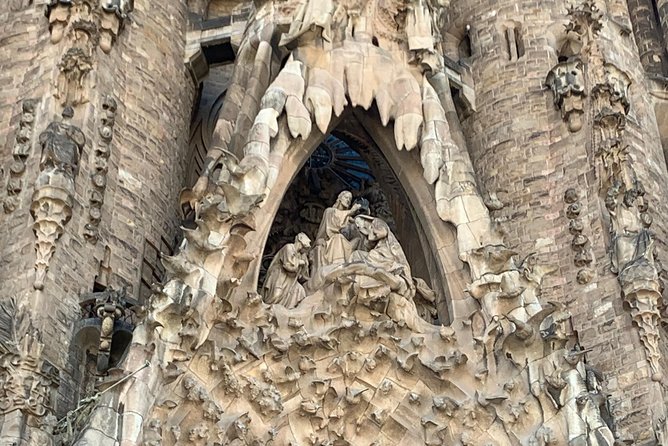
The interior is where Gaudí’s ideas become easiest to understand. Instead of seeing only the famous towers from the outside, you can look upward at the structure, light, and detail from within. The supplied description stresses a calmer visit without long lines or rooms packed with people, but crowd levels can never be guaranteed.
The guide’s explanation can make a major difference here. One past outing was praised for making the basilica’s history and design much clearer, while another included a six-hour version that kept the family engaged through the city’s past and the church’s architecture.
You should also note a practical inconsistency in the published details. The main description says the tour ends at Sagrada Família, while the meeting information says the activity ends back at the starting point. Confirm the final drop-off arrangement before the day of the tour. Do not assume you will be returned to the Gothic Quarter unless the operator confirms it.
Tapas, timing, and the real pace of the day
The food portion adds a welcome change from buildings and dates. Past arrangements have included nougat at Planelles Donat and a meal at Orio with pintxos, wine, and beer. That gives you a taste of Barcelona’s casual dining culture rather than a formal restaurant dinner.
The schedule is still demanding. The listed stop times add up to less than five hours, but the remaining time is needed for walking, food, transfers within the city, explanations, restroom breaks, and the Sagrada Família visit. One outing covered roughly 12,000 steps in five hours.
This is why your group’s pace matters. A private tour can adjust to mobility needs, jet lag, or a strong interest in one sight, but every extra pause means something else may receive less time. A past booking was shortened to three sights after the guide adjusted for late arrival, mobility concerns, and fatigue. That flexibility can be kind and sensible, but it also means you should not view every listed stop as guaranteed in full detail.
Wear comfortable shoes and bring water. Breaks for refreshments and restrooms are included, but the route remains active.
Is $264.34 per person a fair price?
At $264.34 per person, this is not a budget walking tour. You are paying for a private guide, a carefully planned route, the included Sagrada Família entry, and the convenience of combining several districts in one outing. Group discounts may improve the per-person cost for larger parties.
The price makes the most sense in three situations:
- You have only one day in Barcelona and want a guided first look.
- You are traveling with family or friends and prefer a private pace.
- You want help making sense of Gaudí and the old city rather than collecting exterior photos alone.
The value is weaker if you already know Barcelona well, want long interior visits at Casa Batlló or La Pedrera, or prefer to wander without a fixed schedule. Those admissions are not included, and the short stops do not replace dedicated visits.
The high published rating of 4.8 from 18 ratings, with 94 percent recommending the experience, fits the tour’s strongest qualities: engaging guides, private attention, good food, and an effective first-day route. The low rating also points to the key risk, which is that a full list of places cannot always be completed as a leisurely visit in five hours.
Who should book this Barcelona tour?
I would choose this tour for a first-time visitor who wants a clear introduction without handling Barcelona’s booking and routing alone. It also suits families, couples, and small groups who enjoy asking questions and changing the pace as they go.
The experience is a good fit if you like history, architecture, food, and a fair amount of walking in one package. It is less suited to you if you want a relaxed day, extensive museum time, or a guaranteed long visit inside every Gaudí building.
Before booking, confirm the tapas arrangements, the exact Sagrada Família entry time, which admissions are included, and where the tour ends. If those points match your plans, the private guide and included basilica visit can justify the price. If you want depth over breadth, book Sagrada Família and one Gaudí house separately and spend the rest of your day at a slower pace.
FAQ
How long does the Barcelona tour last?
The experience lasts approximately five hours, although one past outing continued for six hours.
What time does the tour begin?
The Sagrada Família portion is planned for an afternoon time beginning around 4 p.m. The exact tour start time should be confirmed when booking.
Where does the tour start?
The meeting point is Av. de la Catedral, 7, in Barcelona’s Ciutat Vella district.
Is the tour private?
Yes. Only your party takes part in the private activity.
Is Sagrada Família admission included?
Yes. Admission to the one-hour Sagrada Família visit is included.
Are Casa Batlló and La Pedrera admission tickets included?
No. Admission is listed as not included for both Casa Batlló and La Pedrera.
Is Barcelona Cathedral admission included?
No. The Cathedral stop lists admission as not included.
Does the tour include tapas?
Yes. Tapas are part of the experience. Past food arrangements have included traditional nougat and pintxos with wine and beer, but the exact venue and menu should be confirmed.
How much walking is involved?
The tour involves substantial walking. One outing covered about 12,000 steps in roughly five hours.
Can I cancel for a full refund?
Yes, if you cancel at least 24 hours before the experience start time. Cancellations made less than 24 hours in advance are not refunded, and poor weather may lead to a new date or a full refund.
More Day Trips in Barcelona
- Barcelona in 1 Day: Sagrada Familia, Park Guell, Mila, tapas
★ 5.0 · 4 reviews
Recently reviewed in Barcelona
- Barcelona Morning Tapas Crawl by Food Tour★ 5.0 · 45 reviews
- Wine & Cava Penedes Tour: Wineries, Wine Tasting and Tapas★ 5.0 · 5 reviews
- Barcelona Sailing Experience: Spanish Tapas and Premium Open Bar★ 4.5 · 34 reviews
- Tapas Bike Tour Barcelona★ 5.0 · 8 reviews
- Barcelona Tapas & Wine Private Tour in Traditional Taverns★ 4.5 · 60 reviews
- Tapas & Sidecar Motorcycle Barcelona Tour★ 5.0 · 26 reviews
- Tapas and Wine Walking Tour in Barcelona★ 5.0 · 47 reviews
- Barcelona’s Most Terrific of Tapas Tours in the Gothic quarter★ 5.0 · 2 reviews
Old Town Tapas Walks, compared.

Valencia Old Town Tour with Wine & Tapas in 11th Century Historic Monument
Read our review →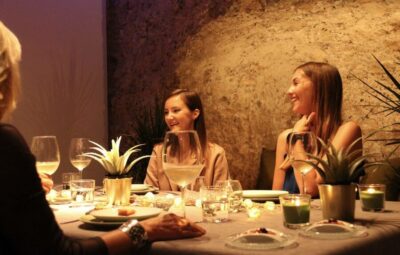
Old Town Tour, Wine & Tapas in an 11th c. Monument
Read our review →
Barcelona Gothic Quarter Tapas & Taverns Food & Wine Tour
Read our review →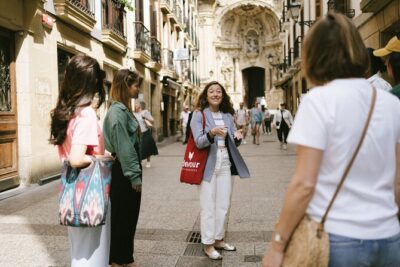
San Sebastian Old Town Pintxos & Wine Tour Small Group Tour
Read our review →
El Born and Gothic Quarter Wine & Tapas Bar Tour
Read our review →
Barcelona Old Town Tapas Tour: Vermouth, Bites & Hidden Gems
Read our review →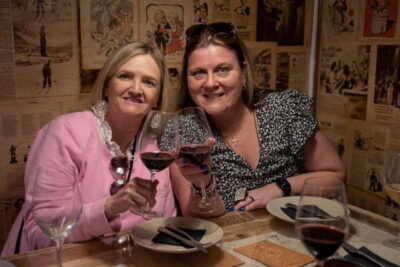
Barcelona Old Town Tapas Night: Hidden Bars, Cava & Vermut
Read our review →
Private Tour: Tapas, Wine & Flamenco Show in Barcelona’s Old Town
Read our review →Browse the lists this tour appears in